
The Theological Virtues
Fundamental Courses of Learning Godly Knowledge and Wisdom

Prolegomena: Introduction
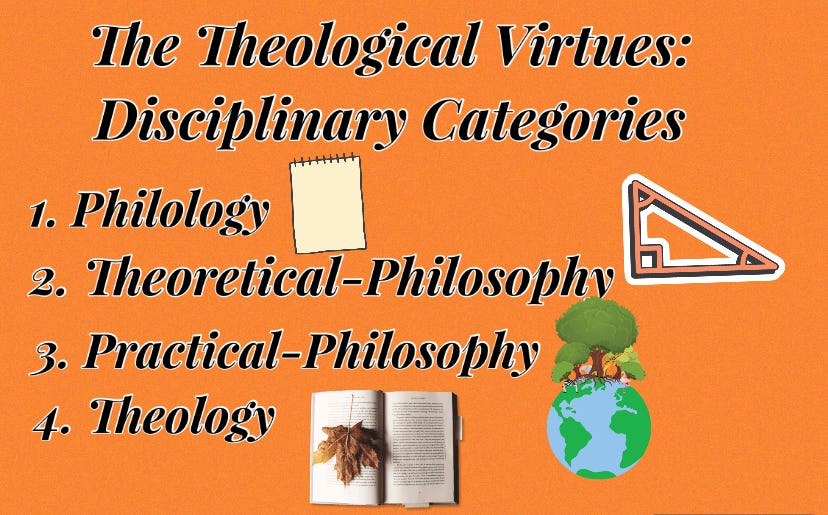
In my previous article, I introduced you all to Reformed Classical education, and I mentioned in that place that I would do a follow up article on the Liberal Arts. These introduction articles are written to, teach you, give you the tools for further learning, and provide practical actions for you to join me in this endeavor or start your own school. In the prior article, I defined the words, Liberal Arts, in their lexical significances. Now, in this current article,I will categorize them in their specified classifications. The Liberal Arts have a long history, and they are the habits by the means which God created man to learn about Him and His creation. Another way of expressing it is, that God created man with an intellect that can grow in true knowledge and wisdom through Him enlightening man's dialectical reason to bring him to the knowledge of the truth. The term, Liberal Arts, has a Pagan origin. It is better to name them Theological Virtues, Arts, or Sciences, since they are the rules and order that God created for the proper use of that particular part of creation (Romans 1:20). Philippians 4:8-9 is one place where God speaks to man growing in true godly knowledge, “Finally, brethren, whatsoever things are true, whatsoever things are honest, whatsoever things are just, whatsoever things are pure, whatsoever things are lovely, whatsoever things are of good report; if there be any virtue, and if there be any praise, think on these things. Those things, which ye have both learned, and received, and heard, and seen in me, do: and the God of peace shall be with you.” Man does not have the authority invent his own way of learning, rather God created man to learn through an enlightened comprehension. The Puritan, Thomas Hall, makes this clear when he states, 1Let Philosophy, like a servant, be subject to Theology; he is servant, not Master. Therefore, man must learn at all times through the arrangement of Disciplines that God in His creational order designed for him to learn by. That arrangement of the Disciplines is the Liberal Arts, but we will call them Theological Virtues, and there are twenty two Theological Arts. All are contained in four orders of Science. Those four orders of Science are:
1. Philology
2. Theoretical-Philosophy
3. Practical-Philosophy
4. Theology/ Chief of the Sciences.
I will expound on these four sciences and the twenty-two Theological Virtues classed with them in a few subsequent articles. In this article, we will begin to learn the six Arts of Philology.
Philology
Philology, is the Theological Art/ Discipline/ Science of using words rightly, in writing, speaking, and reasoning. The Dutch Reformed minister, Johann Heinrich Alsted, defines Philology in this manner, 2“And therefore, Philology, thus it is called, which explaineth the Arts of Speech and Reason.” Philology is the most rudimentary Science, and it equips us to understand all of the Arts to follow. Philology consists of six of the twenty two Liberal Arts; properly named, the Arts are: 1. Lexica, 2. Grammar, 3. Rhetoric, 4. Logic, 5. Oratory, and 6. Poetry.
1. Lexica
Lexica, is the Theological Virtue of teaching the signification of words and collecting words in a lexicon, and alternately it is known as Lexigraphy. Lexica comes from the Greek word, λόγος, which is defined as: word, speech, dialectic, and oration. It is here that you observe how all six of the Philological Sciences are contained in this word, λογος. When I defined the word, λόγος, I gave you an example of Lexica. Lexica, as well as all the other Theological Arts, are found in Scripture. One place the sense of Lexica is found in Scripture is, 1 Corinthians 14:9-11, which says, “So likewise ye, except ye utter by the tongue words easy to be understood, how shall it be known what is spoken? for ye shall speak into the air. There are, it may be, so many kinds of voices in the world, and none of them is without signification. Therefore if I know not the meaning of the voice, I shall be unto him that speaketh a barbarian, and he that speaketh shall be a barbarian unto me.”
The internal purpose of the Lexica is to collect the meanings of words; the external purpose is to teach and learn those meanings.
In both cases the happenstance of the words are attended to, in this order:
1. Origin/ Etymology: in which the word is the source of other words, and to understand the morphological nature of words, i.e. (prefix, root, suffix)
2. Congruence, Incongruence: That is the similarity of several words in themselves and the dissimilarity of them.
3. Analogy, Anomaly: or, Regularity, Irregularity: An Analogy is in relationship between related words and things, while and Anomaly is when a word goes against the rule of a language.
4. Dialect: which is the variation of the voice in the pronunciation of words, as it relates to the diversity of speakers in one language.
5. Peregrinity: is when a word is translated from another language in such a way that the linguistic origin remains the same in the translated language.
6. Antiquity: which is when a word, used in ancient times, has ceased to be in use in the same manner with the progress of time.
7. Novelty: which when a word, unused in ancient times, was brought into use with the progression of time.
8. Propriety: which is the primary imposition of meaning.
9. Modification or Impropriety: which is the imposition of an adventitious meaning.
10. Ambiguity: which is the variety in the signification of one word.
11. Synonymia: from σύν (sun), together with, and ὄνομα (onoma), a name. A Synonym is when the sense of two or more words is similar, though the etymology is different.
12. Syncrisis: from, σύγκρισις, from σύν (sun), together with, and κρίσις (crisis), a judging or deciding. Hence, Syncrisis is the judging or comparing of one thing with another; and is used of the figure which consists of a repeated Simile, or of more than one, or of a number of separate comparisons used together.
13. Antithesis: from ἀντίθεσις, from ἀντί (anti), against, and θέσις (thesis), a setting. An Antithesis is when words and phrases are set against each other to make the argument more emphatic. A Scriptural antithesis is in Romans 5:18, ”Therefore as by the offence (παραπτωματος) of one judgment (κατακριμα) came upon all men to condemnation; even so by the righteousness (δικαιωματος) of one the free gift came upon all men unto justification (δικαιωσιν) of life.“
2. Grammar
Grammar, is the Theological Art of proper verbalization, both in written and spoken words. It originated from the Greek word, γράμματα- (grammata), which means the letters of the alphabet, learning, and written documents. All the languages of the world originated from Hebrew, since Hebrew was the original language that God imbued into Adam and Eve at creation. Samuel Bochart, the French Reformed Pastor, further explains the Hebrew origin when he says, 3“In the Creation God inspired into Adam and Eve, the first moment in which they were created, the knowledge of the Hebrew tongue, that so that they might understand the language of God conversing with them; as also enjoy mutual conference and conversation amongst themselves. This same power God shone forth in the confusion of the languages, which God only introduced, Gen 11:7 confound their language.” Thus, from the beginning, God made languages, and all languages follow specific rules to be intellectually understood. Fittingly, languages have letters, syllables, words, and sentences, moreover, each of these grammatical instruments has its proper rules for verbalizing correctly.
2.1 Letters
The etymology of the word, letter, tells us the purpose that God created letters. The word, letter, originated from the Latin word, Littera. Littera, stems from, iter, meaning a road, path, rout, or journey. The other word that Letter stems from is, legere, meaning to read. Letters were decreed by God for the purpose of leading man to read. Letters are signs of words. Augustine, in his work, ON CHRISTIAN DOCTRINE, explains how letters are signs of words, 4“For a sign is a thing which, over and above the impression it makes on the senses, causes something else to come into the mind as a consequence of itself…”. Letters and words signify concepts and objects, which means that they direct man to something other than themselves. These concepts and objects are either corporeal or incorporeal, so give you a few examples, the Bible, God, Pedagogy, and water. Letters are the contingent elements of syllables, and syllables are the elements that construct words.
There are two types of letters, they are first divided into two groups, vowels and consonants.
Vowels: are letters that are released in various ways through the straightforward opening of the throat, without any contact of the mouth. And they are called vowels, because they make a complete vocal sound on their own, and on their own they may make a syllable with no adjoining consonant.
Consonants: are letters that are produced by various motions of the tongue or a compression of the lips. And they are called consonants because they do not produce sound by themselves, but rather sound together with an adjoining vowel. Consonants are divided into two groups: semivowels and mutes.
2.1 Semivowels: are so called because they take a certain half of their quality from vowels. Their letter-names, accordingly, begin with the vowel.
2.2 Mutes: are so called because, without vowels joined to them, they are never released. In fact, if you were to remove the sound of the following vowel from them, the sound of the letter will be a blocked murmur.
Philosophia tanquam famula sit Theologiae subdita; ancilletur, non Dominetur., Pg. 45 from his book, Vindiciæ Literarum, the Schools Guarded, or, The Excellency and Usefulnesse of Humane Learning in Subordination to Divinity
Johann Heinrich Alsted. Encyclopaedia: Septem tomis distincta, I. Praecognita disciplinarum, libris quatuor. II. Philologia, libris sex. III. Philosophia theoretica, libris decem. IV. Philosophia practica, libris quatuor. V. Tres superiores facultates, libris tribus. VI. Artes mechanicae, libris tribus. VII. Farragines disciplinarum, libris quinque : Serie Praeceptorum, Regularum, & Commentariorum Perpetua ; Insertis passim Tabulis, Compendiis, Lemmatibus marginalibus, Lexicis, Controversiis, Figuris, Florilegiis, Locis communibus, et Indicibus; ita quidem, ut hoc Volumen, secundâ curâ limatum et auctum, possit esse instar Bilbiothecae instructissimae. N.p.: n.p., 1630, 132.
Samuel Bochart, Samuelis Bocharti Opera Omnia.: Hoc Est Phaleg, Canaan, et Hierozoicon. Quibus Accesserunt Dissertationes Variae Ad Illustrationem Sacri Codicis Aliorumque Monumentorum Veterum. Praemittitur Vita Auctoris à Stephano Morino Descripta et Paradisi Terrestris Delineatio Ad Mentem Bocharti. Indices Denique Accurati & Mappae Geographicae Suis Locis Insertae Sunt. in Quibus Omnibus Digerendis Atque Exornandis Operam Posuerunt Viri Clarissimi Johannes Leusden & Petrus de Villemandy, ed. Pierre de Villemandy et al., vol. 1, 2 vols. (Lugduni Batavorum, Caen, France: Apud Cornelium Boutesteyn, & Samuelem Luchtmans., 1646), 59.
Augustine Of Hippo, On Christian Doctrine De Doctrina Christiana Is a Theological Text Written by Saint Augustine of Hippo. It Consists of Four Books That Describe How to Interpret and Teach the Scriptures (Beloved Publishing, 2020), 38.